- Vendry
- Posts
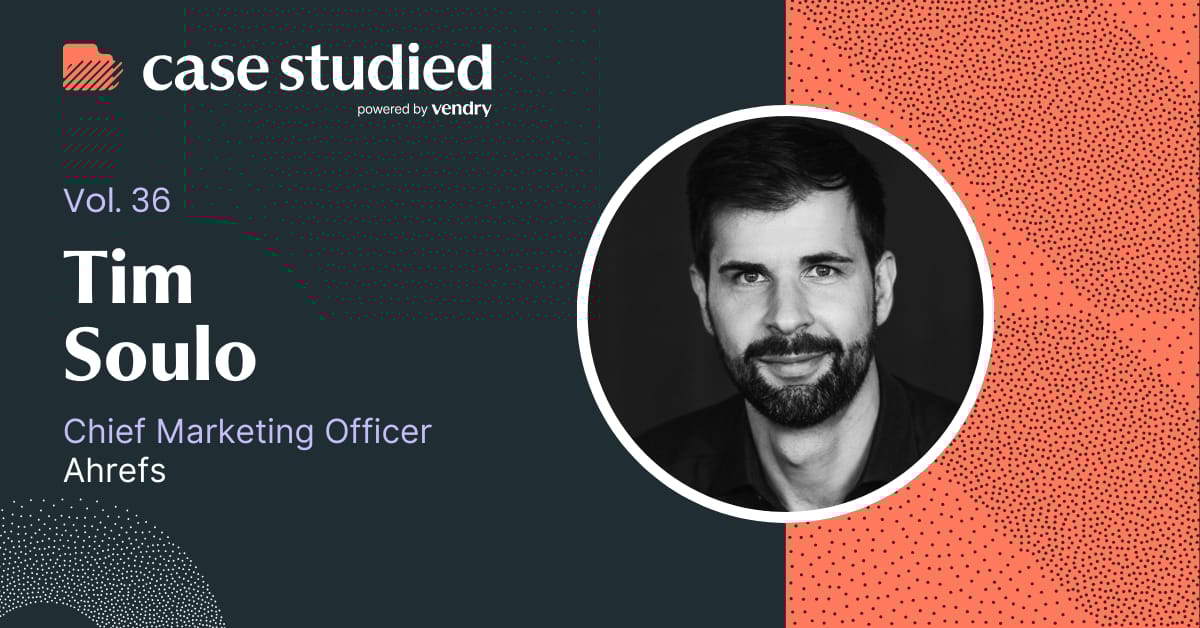
- Vol 36. Insights from Ahrefs CMO Tim Soulo
Vol 36. Insights from Ahrefs CMO Tim Soulo
Ahrefs CMO Tim Soulo shares insights on becoming discoverable, experimenting boldly, and scaling a global SaaS brand.

Case Studied Experts
December 11, 2025
Case Studied Experts
Meet Tim Soulo
Each week, we sit down with a marketing leader to learn more about their career, insights, and accomplishments.
This week, that leader is Tim Soulo, CMO of Ahrefs. Tim’s career took him from technical support agent to nightclub DJ to SEO novice in the earliest days of the industry. At Ahrefs, he’s helped fuel the company’s growth through an unconventional philosophy that focuses on fundamentals, ignores busywork, and ships relentlessly.
Here are the need-to-knows about Tim:
He joined Ahrefs in 2015 as employee No. 16, when the company had fewer than 20 employees and under $8M in annual revenue.
Under his marketing leadership, Ahrefs has grown to over $100 million ARR without a sales team, fueled almost entirely by inbound.
He and his team launched some of the company’s most beloved brand projects, including the Ahrefs SEO for Beginners book and a children's book that became an unexpected enterprise hit.
Exclusive Subscriber Perk
The World’s Fastest (and FREE) Agency RFP!
When we launched Case Studied back in 2023, the feedback we got from the marketing leaders that read our newsletter was that they wanted us to provide services that:
Help their teams improve performance and sales
Save them time and increase their bandwidth
Doesn’t cost anything / presents zero risk to leverage
Vendry RFP is all of those things in more - we conduct on average 50 agency RFPs a month for our subscribers spanning everything from Marketing, Design and Development. Notable clients include Thrive Market (Retail), Zscaler (SaaS), Rula (Healthcare), F1 (Entertainment) & 100’s more.
To get started book a 15-minute call with our team, describe your agency brief and then receive 3 handpicked and vetted matches in under 2-weeks.
Zero cost to you. No commitment. Save 20+ hours vetting.
Stepping into SEO
Before marketing ever entered the picture, Tim was juggling two jobs: DJing at a nightclub and working in technical support for a hosting company. At 20 years old, he realized neither path was his future. “I wasn’t enjoying technical support,” he recalled. “And to be a successful DJ, you have to party a lot. That was never my thing.”
A friend mentioned SEO, describing it as “some magic role where you help websites rank better in Google.” Tim decided to give it a shot. His first role at FlashMint involved writing keyword-stuffed template descriptions and buying backlinks in what he now calls the “wild west” era of SEO.
“Back then, Google wasn’t as good at figuring out what was spam… buying links worked incredibly well,” he said.

Even though the day-to-day work wasn’t inspiring, Tim fell in love with the industry through its community, specifically, SEOmoz (now Moz). He became an active participant, devouring Rand Fishkin’s Whiteboard Fridays, reading the blog religiously, and eventually writing articles that became some of the platform’s most-read pieces of the year.
“SEOmoz and Rand Fishkin are what inspired me to pursue this career,” he said.
Becoming discoverable
While working various SEO jobs, Tim built BloggerJet, a personal blog where he ran experiments and documented what he learned. He built WordPress plugins, created content analytics tools with a developer friend, and published anything he thought might help other marketers.

This public footprint is what Ahrefs founder Dmitry Gerasimenko eventually noticed. “He saw my activity online,” Tim said. “He checked out my blog, my accolades… and he reached out to me.”
Tim initially thought a previous outreach attempt to Ahrefs’ blog team had sparked the connection. But Dmitry later clarified he had discovered Tim independently through his contributions on inbound.org, where Tim was one of the most active, recognizable members.
What began as a freelance writing arrangement quickly evolved. Dmitry realized Tim could offer far more than blog posts and invited him to Singapore to lead marketing full-time. In recalling everything that led to the opportunity, he pointed out, “You need to be discoverable. You need to be easily researched… your website, your footprint in communities, your track record of what you’ve built.”
Learning SEO again

When Tim joined Ahrefs, he already considered himself fairly experienced. But he quickly realized how much he didn’t know.
One vivid example came from comparing backlink indexes between tools. When Moz reported backlinks that didn’t exist anymore, Dmitry explained that their crawler likely hadn’t updated yet. “It was a great epiphany,” Tim said. “If I don’t know it, then tons of other people don’t know it. So let me push this information out there.”
His early years at Ahrefs followed a simple loop of learning, simplifying, teaching, and repeating. Unlike most SaaS companies, Ahrefs didn’t obsess over personas, ICPs, or marketing templates. Tim found that to be “busywork.”
“That is not the kind of work that moves the needle,” he said. Instead, his team focused on use cases and real problems people were trying to solve.
Under that philosophy, Ahrefs grew entirely inbound for years. Growth was driven by blog content, YouTube tutorials, and enthusiastic word of mouth. They didn’t have a sales team. Instead, they just doubled down on discoverability.
Even as AI changes how people search, Tim believes these principles remain the same. “People will keep searching in 10 years from now,” he said. “The systems of how to get yourself ranking at the top of the search might change and you might need to adapt. But people discover business by either searching, noticing, or talking about them. And I think those fundamentals will stay the same. ”
A standout campaign

Though Tim doesn’t think in “campaigns,” one project does stand out: Ahrefs’ SEO book for beginners.
The idea began when he ordered a physical book from Intercom and was struck by its craftsmanship. “I loved this experience of holding something from a brand in my hand,” he said. “I wanted to do something like that.”
The early attempts didn’t work. A ghostwriter couldn’t capture Ahrefs’ tone. An internal attempt didn’t work either. So eventually, Tim changed tack: instead of writing from scratch, the team would adapt seven existing blog articles into a cohesive, beautifully designed book.
From there, the project took off. The design team crafted a premium layout. Tim decided to promote the book with a video and hired a comedian to help sharpen the script. A videographer shot the promotional footage like an Apple ad, except the product was a book. And he even contacted Intercom to use their book printer.

The result was something people wanted to hold. At conferences, they ran out of copies before lunch. Customers emailed asking to buy it, despite no marketing push. Thousands of copies sold through a simple storefront created by the printer.
“There was nothing unique about the content,” Tim said. “It stood out because of the effort we put into making it beautiful and the emotion when you hold it in your hands.”
Advice and Takeaways
1) Be discoverable.
The opportunity to lead marketing at Ahrefs came to Tim because he consistently put his work into the world. He contributed to forums, built small products, and openly shared his experiments. By doing so, he made it remarkably easy for the right people to find him.
Consider your own digital footprint. Are you easily discoverable through a website or a community? Do you share the tools or ideas you’re working on? Opportunities tend to follow people who show their work so showing up in those spaces can be a worthwhile effort.
2) Do the work that actually moves the needle.
Throughout his career, Tim avoided the kinds of marketing tasks that generate slide decks but no results. He didn’t believe in over-engineering personas or creating strategy documents that delayed action. Instead, he focused on execution: identifying real problems, creating useful content or tools, and shipping quickly.
Take an honest look at where your team spends time. Are you producing work that drives learning and momentum? Consider what guardrails you can implement to prevent over-planning and prioritize creation, distribution, and iteration.
3) Experiment boldly, even when you can’t measure it perfectly.
One of Tim’s most unconventional beliefs is that not all marketing needs tight attribution to justify itself. At Ahrefs, his team relied on a combination of logic, first-principles thinking, and qualitative signals (not dashboards) to understand whether something was working. “Do things, see if they work,” he said. “That’s basically it.”
Could you give yourself more permission to experiment without over-engineering the measurement plan? If you can clearly articulate why an idea makes sense, what needs it serves, and how it fits into the broader discovery ecosystem, give it a try. Look for directional signals like feedback, resonance, and conversation rather than picture-perfect attribution.
Think long-term: What could help make your campaigns more successful over time? The right agency partner. And Vendry can help you meet yours, for free. Get started.